Google Ads :

Tuesday, May 7, 2013

Top 10 Camping Tips


10.Find or Create Shelter Before Dark

One of the most important camping tips is this: Always pitch camp before dark. You'll need to decide on a type of camp housing that suits your fancy, whether that's a tent, recreational vehicle (RV) or a cabin. Some adventurers go primitive and literally sleep under the stars in a hammock. If that's too bare-bones for you, then you may consider packing a tent for your outdoor adventure. Although they're probably the most basic shelters for camping, tents can be rather comfortable with the proper preparation. Ask the salesperson at the outdoor recreation store to recommend a suitable tent for your needs. These needs will determine the size, shape and quality of the tent you select. Keep in mind that with tents, bigger isn't necessarily better -- you'll have to lug it to your campsite, after all. Be sure to try your tent out at home to detect any problems so your camping trip doesn't turn into a nightmare. Bring extra tent poles just in case yours break; that's not unheard of. Keep a window or two slightly unzipped at night to reduce moisture inside the tent. Also, pack an old shower curtain (one that's slightly smaller than the size of your tent floor) to place on the ground to keep you dry in case it rains.
Roll on over to sleeping bag camping tips in the next section.

9.Pick a Season-appropriate Sleeping Bag

The utmost camping tip having to do with sleeping bags is this: Choose one appropriate for the season. A lightweight sleeping bag will do in warmer months but in the winter you'll need one that's got a lower temperature rating. Always go with one that will keep you toasty in a lower temperature range than you actually plan to camp in, just in case the mercury drops. If you'll be sleeping in a tent, you'll want to opt for a mummy-shaped sleeping bag. This type fits closely around your feet, preserving body heat, and it's also easier to pack. In terms of materials, a sleeping bag filled with synthetic fibers will dry quicker than one stuffed with down, and it's also nonallergenic. But a goose-feather sleeping bag is easier to carry because it's lightweight.
To enhance your sleeping experience with your sleeping bag, place a pad or long cushion beneath it for a much more comfortable slumber. Instead of packing a pillow, improvise by inflating a large, heavy-duty plastic bag, and use that to cushion your head.

8.Pack the Bare Necessities for Mealtime

A list of camping tips wouldn't be complete without mentioning food and water. Whether your camping trip entails mini adventures, such as hiking or canoeing, or if it just means kicking back in the RV and watching DVDs, you're going to need food. The rule of thumb is to take only what's necessary to prepare each meal. For example, if your group is small, bring two cups of quick-cook oats rather than an entire 48-serving canister of oatmeal. Use sealed plastic bags to mix food. If you're setting up camp next to your RV or car, you have the luxury of being able to use a cooler to keep perishable goods like meats from spoiling.
Making sure you have clean water is one of the most essential camping tips. Unless you have access to clean tap water or a spring you know is safe to drink from, you should carry bottled water with you. Or, you can bring packets of iodine to sanitize water you get from the backcountry or any questionable source. You can also run the cleanest water you can find through a water filter or boil it for at least 10 minutes. To keep your water cold, wrap your container in aluminum foil.

7.Leave No Trace

As you're living it up on the open range, keep this next camping tip in mind; it will help you protect and preserve nature so that you and future generations can enjoy it again and again. Leave no trace, meaning pick up after yourself to leave the ecosystem undisturbed. Clean up thoroughly after meals and secure your food high above the ground.
Although they may seem like common sense rules, you may not be entirely familiar with the principles of leaving no trace. Plan ahead and prepare to travel in smaller groups, containing most activities at least 200 feet (60.9 meters) away from streams and lakes. Travel and camp on established trails and campsites. Bury solid human waste 6 to 8 eight inches (15 to 20 centimeters) below the surface of the ground. Take baths and wash dishes 200 feet (60.9 meters) away from streams and lakes as well. Strain dishwater, disposing of large particles in proper waste receptacles and strewing the used water. Leave all artifacts and natural objects as you find them. Use established fire rings, keep campfires small, and cook on a stove. Keep your distance from wildlife, and don't feed the animals.

6.Dress for the Occasion

Even if you're not fashion-conscious, planning outfits for your outdoor adventure is just as important as any other camping tip. Dress in loose layers of clean clothing. Of course, in months with colder weather, you'll wear more clothing -- such as hats, gloves, jackets and thermal underwear -- than in warmer seasons. The key is to peel off layers of clothing before you start sweating so that you stay dry. If you perspire and get your clothes damp, you won't be as comfortable as you'd like.
Then, there's footwear. When you're camping, you need to protect your feet. Wear closed-toe shoes that have some sort of moisture-absorbing lining. Hiking boots are ideal, and one way to prevent blisters when you're exploring trails is by rubbing a bar of soap on your heels and underneath your toes before you head out. Keep the soap with you, and if your feet become tender, apply more soap to any potential hot spots.
Always pack a waterproof poncho to protect you from the rain; the last thing you want is to get your clothing drenched. Wearing wet clothing could cause hypothermia.

5.Avoid Bugs, Bears and Poisonous Plants

This set of camping tips concerns bugs, bears and poisonous plants. When pitching your tent or setting up another type of shelter, be on the lookout for wasp nests and other insects and bugs. If you're hanging out near vegetation, it's a good idea to wear a long-sleeved shirt and long pants. It won't hurt to apply insect repellent either. Check yourself frequently for ticks as well.
You probably know to avoid poison ivy and how to spot its three-leafed clusters. Poison oak and poison sumac -- which tend to have more than the three telltale leaves per bunch -- are also ones to watch out for. Wearing clothing that covers you from head to toe when you're near plants, bushes and trees will help reduce your chances of getting a rash. It's a good idea to have calamine lotion and an antihistamine or allergy medicine on hand in case you come across an irritant.
As we learned earlier, proper storage and disposal of food helps keeps bears from crashing your wilderness party. Secure food items high above the ground, such as on a rope or very tall tree branch.

4.Don't Get Lost

Experienced camping enthusiasts know this camping tip, so plant it in your brain: Don't get lost. It's a major mistake campers make, but you can avoid wandering too far away from your campsite by carrying a few simple tools at all times. A compass, map and GPS device can keep you from disappearing into the land of the lost. Of course, none of these tools will do you any good if you don't know how to use them. So, take some time well in advance of your camping trip to learn how to read a map and use your compass and GPS. (Plus, by the time you get to the end of this article, you'll have even more camping tips under your belt to keep you on track.)

3.Tote a Survival Kit

When it comes to camping, nothing could be truer than the Boy Scout motto "Be prepared." Carrying a survival kit when you venture away from your campsite is an indispensable camping tip. So, what do you pack in this kit? For starters, you'll want to have water-purifying tablets, a water filter and a metal bowl. Then, add a survival knife, which can be used to hunt, to protect yourself and to signal for help. Not just any blade will do; it's worth investing in one from a camping or outdoor goods store.
Another must-have in your survival kit is waterproof matches stored in an airtight container. You can make waterproof matches by dipping regular ones in either nail polish or paraffin. A plastic medicine bottle or 35 millimeter film container makes a handy caddy for your waterproof matches. Keep a flashlight in your survival kit, and store extra batteries in an airtight container similar to the ones you store your matches in. Having a flare gun and a mini LED torch aren't a bad idea, either.
In addition to toting a survival kit, you should also have a small first aid kit with you. Stock bandages, wound cleanser, latex gloves and cold packs in it.

2.Practice Good Hygiene

We mentioned earlier in the camping tips section on clothing that cleanliness is important. The same goes for your body, no doubt. But you may be wondering how to maintain hygiene in less than ideal conditions. Keep a bottle of hand sanitizer in your pocket, and always cleanse your hands before eating, drinking or putting your hands near your face. Use rubbing alcohol and cotton balls to freshen up nonsensitive areas of the body. Use a sponge, a bowl of water and biodegradable soap to take bird baths once or twice a day. Brush your teeth using purified water with toothpaste or baking soda, and follow with dental floss. Your feet will get pretty grimy while camping, so take advantage of moments near a stream to take off your shoes and soak your feet in the water for a few minutes. Steer clear of colognes, perfumes and fragrant lotions because they attract bugs.
Wrap various personal hygiene items like your washcloth, toothbrush and soap individually in aluminum foil when you're packing up to ensure that the rest of the stuff in your backpack stays dry.

1.Take Extra Precautions When Camping with Kids or Pets

Camping with kids or pets takes a lot of work, but it can be a pleasant experience. As we've learned, planning is the secret to successful camping. This carries through to camping with your children and furry friends. Be sure to have the appropriate clothing to protect your child, whether that means sun hats in the summer or warm, long-sleeved clothing he or she can wear if the outside temperature suddenly drops. Next, just like you practice a fire drill, work with your children to help them learn how to prevent getting lost and what to do if this should happen. Provide a flashlight or glowstick to each child, and review the rules several times a day to remind children what to do to stay safe.
Bringing your dog on your camping trip can make even a modest shelter feel like a home away from home. A few things you'll need to ask yourself is whether you're equipped and willing to restrain your pet should a wild or domestic animal wander by. Also, you want to be sure that your pet's vaccinations and licenses are current. Of course, you need to bring your dog's leash, and keep the pet contained at all times. You'll need to provide your dog's food in a clean bowl, as well as fresh clean water, in addition to properly cleaning up and disposing of its waste.


The Top 10 Most Influential People in History

1.Ashoka the Great

Life-Span: 304-232 BC
Country of Origin: India India
Most Significant Accomplishment: Kick-started the global spread of Buddhism
Crude Estimate of the Number of Human Lives Affected: 21.534 billion

Ashoka the Great was an Indian Emperor who ruled 274–232 BC. In his early reign, he embarked on a number of military conquests which spread the size of his empire over much of India, Pakistan, Afghanistan, Bangladesh, Nepal, and even parts of Iran. However, during one of these wars of conquest, Ashoka became repulsed by the number of deaths that he witnessed and decided to reject violence for the rest of his life, embracing Vedic Buddhism and vegetarianism.
           Ashoka the Great’s greatest accomplishment was his non-violent propagation of the Buddhist Faith across Asia, and even into Europe and Africa. He sent his only daughter Sanghamitta and son Mahindra to spread Buddhism in Sri Lanka. Ashoka also sent many prominent Buddhist monks to modern Kashmir, Afganistan, Bhutan, China, Mongolia Cambodia, Laos, Burma, Thailand, Vietnam, Persia, Egypt, and Greece. Ashoka’s efforts helped to spread Buddhism across East Asia, where it has become the dominant faith of that region. Ashoka’s efforts to spread Buddhism in the west were much less successful. Nevertheless, there is evidence that a small Buddhist community began to develop at the Greek city of Alexandria in Egypt at this time. It has even been suggested that certain Ptolemaic Greek philosophers were influenced by Buddhism and that they in turn influenced the early development of Christianity.


2.Saint Paul of Tarsus


Life-Span: 5–67 AD (approx.) 
Country of Origin: Turkey Turkey
Most Significant Accomplishment: Took a lead role in bringing Christianity to Europe 
Crude Estimate of the Number of Human Lives Affected: 18.465 billion

In approximately 50 AD, when St. Paul set off on a ship from Troas, crossing the Aegean and arriving in the shores of Europe, he probably did not know the significance that this move would have in world history. It was here that Christianity made it’s first documented appearance in the continent that would later become virtually synonymous with “Christendom” throughout the Middle Ages. 
           St. Paul referred to himself as the Apostle to the Gentiles and was also one of the main contributors to the New Testament Bible. Thirteen epistles have been attributed to him. His writings are still cited today as an authority on Christian behavior and belief.


3. Jesus Christ

Life-Span: 5 BC-30 AD (approx.) 
Country of Origin: Israel Israel
Most Significant Accomplishment: Founder of Christianity 
Crude Estimate of the Number of Human Lives Affected: 18.468 billion

While the historicity of Jesus Christ is disputed, both Christians and Muslims believe him to have been a prophet of God, and Christians believe that he was the son of God. Many miracles have been attributed to Jesus, such as being born of a virgin, healing leprosy, curing the blind, exorcism, and resurrection. However, belief in Jesus’s supernatural abilities were not that out of the ordinary as many prophets, soothsayers and magicians of the time were ascribed a similar list of traits. What Jesus became most renowned for were his moral sayings. Jesus taught his followers the golden rule (“do unto others as you would have them do to you”), to love even their enemies and oppressors (“turn the other cheek”), and to shun violence (“those that live by the sword die by the sword”). 
           Whilst Jesus was the founder of Christianity, he was himself a Jew and was reluctant to evangelize amongst the gentiles or to cure them of their sicknesses. (Mathew 15:24) The task of spreading Christianity outside of Judea would fall upon his later apostles after his death, the most noteworthy of which was Paul. It was only through their work that Christianity would become a world religion.


4. Gautama Buddha


Life-Span: 563-483 BC (approx.) 
Country of Origin: Nepal Nepal
Most Significant Accomplishment: Founder of Buddhism 
Crude Estimate of the Number of Human Lives Affected: 21.638 billion

Gautama Buddha was born a prince to a small kingdom in Nepal. A prophesy held that Buddha would grow up to be either a great king or a great holy man. Buddha’s father hoped for the former and for this reason he attempted to steer Buddha away from a religious life by raising him in a sheltered environment, concealing all human suffering from his view. This plan backfired; Buddha became shocked by the sight of old age and disease when he witnessed them for the first time as an adult. This led Buddha on a journey away from the luxuries of his home in search of truth and enlightenment.
           Whilst meditating, Buddha received his enlightenment, developing the idea of the Noble Eightfold Path, which are a set of eight ethical principles to live by, including concepts such as honesty and non-violence. Gautama Buddha spent the rest of his life traveling through the Indian subcontinent preaching his new faith. But it was not until after his death, during the reign of Ashoka the Great, that Buddhism would spread beyond this region into East Asia where it has to this day received it’s largest number of adherents.


5. Constantine the Great

Life-Span: 272-337 AD 
Country of Origin:  Serbia 
Most Significant Accomplishment: Established Christianity as the favoured religion of the Roman Empire. 
Crude Estimate of the Number of Human Lives Affected: 18.436 billion

Constantine the Great became Emperor of the Western Roman Empire in 306 AD, and after a civil war, became sole ruler of the entire Roman Empire in 324 AD. When Constantine first came to power, Christianity was a growing religion with a significant number of adherents. Nevertheless the movement had just suffered from it’s most devastating persecution under the rule of the Emperor Diocletian. Constantine became the first Roman Emperor to convert to Christianity and worked tirelessly to spread and promote his new faith across the empire. He legislated freedom of religion for Christians and ordered the return of church property that had been confiscated during the persecutions. He was also praised by the Christian historian Sozomen for ensuring that Christians were placed in almost all the principal positions in government. 
      During Constantine’s reign, Christians were still only a fifth of the population of the western portions of the Empire, but they already made up approximately half the population of the Eastern provinces.(source) This may have been one of the reasons why Constantine decided to move the capital city of the Roman Empire from Rome to a brand new city that he built in the East called “Constantinople". At his new capital he could surround himself with a loyal Christian population and the city was also easily defendable, being surrounded by sea on 3 sides and mountains on the fourth. Constantinople would grow to become one of the largest and most wealthy cities in the world for the next 1,000 years.


6. Muhammad

Life-Span: 570-632 AD
Country of Origin: Nepal Saudi Arabia 
Most Significant Accomplishment: Founder of Islam 
Crude Estimate of the Number of Human Lives Affected: 15.211 billion

Muhammad was an Arabian merchant of the 7th Century AD, who became a self-proclaimed prophet, military commander, and ruler of Arabia. He was the founder of the religion of Islam and the first person in history to unite the various tribes of Arabia into a formidable political and military force. Muhammad rejected religious pluralism and despised the traditional Pagan religions of the Arabs, he famously called upon his followers to wage war against the non-believers until the religion of Islam reigns supreme. (Quran 8.39) This call to arms in the name of God was the first Jihad and would have immense repercussions on world history up to the present. In just 100 years since Muhammad first claimed prophethood, his followers had waged a series of religious wars, conquering lands as far afield as Spain in the west and Pakistan in the East, and subduing every people in between. In fact, such was the success of these religious wars that Christian civilization was almost wiped out entirely from both Asia and Africa, only one small corner of Christian civilization survived in Europe. It would take the Christians of Europe 400 years before they were able to mount any kind of effective response to the forces of Islam and begin topush back the boundaries of the Islamic World (such as the Crusades in the Levant and the Reconquest of Spain, both of these conflicts were heavily influenced by the ideas of Jihad originally developed by Muhammad). Even today, extremist Muslims all over the world continue to be inspired by the words of Muhammad calling on them to wage war on the non-believers that dwell around them. (Quran 9.123)


7. Charles Darwin

Life-Span: 1809-1882 AD 
Country of Origin: United Kingdom United Kingdom 
Most Significant Accomplishment: Pioneered the Theory of Evolution 
Crude Estimate of the Number of Human Lives Affected: 10.962 billion

Charles Darwin was an English naturalist of the Nineteenth Century. He established that all species of life have descended over time from common ancestry, and proposed the scientific theory that this branching pattern of evolution resulted from a process that he called natural selection. He published his theory with compelling evidence for evolution in his 1859 book On the Origin of Species. The scientific community and much of the general public came to accept evolution as a fact in his lifetime. However, it was not until the emergence of the modern evolutionary synthesis from the 1930s to the 1950s that a broad consensus developed that natural selection was the basic mechanism of evolution. In modified form, Darwin's scientific discovery is the unifying theory of the life sciences, explaining the diversity of life.
Darwin was not alone in developing the theory of evolution; Alfred Wallace developed a similar theory independently, and made his theory known to Darwin in a private letter. The two men then came together to present their findings to the scientific community in 1858. Nevertheless, Darwin had begun to toy with the idea of evolution by natural selection as early as 1837, when Wallace was still a child and had spent the interim period gathering evidence and formulating his ideas before publishing. In 1859, Darwin published "On the Origin of Species". The book was written for non-specialist readers and attracted widespread interest upon its publication. As Darwin was an eminent scientist, his findings were taken seriously and the evidence he presented generated scientific, philosophical, and religious discussion. Within two decades there was widespread scientific agreement that evolution, with a branching pattern of common descent, had occurred. Darwin's work has had a tremendous impact on society since the theory challenged beliefs about the creation of life on earth and the place of humans within it.


8. Appius Claudius Caecus

Life-Span: 340-273 BC 
Country of Origin: Nepal Italy
Most Significant Accomplishment:Ensured Rome's domination of Italy 
Crude Estimate of the Number of Human Lives Affected: 18.901 billion

The Roman Empire’s conquest of the Mediterranean and Western Europe, and the stories of Roman Emperors such as Julius Caesar and Octavian are well known. But what is perhaps more impressive is the story of how the Early Roman Republic, confined to a small area of central Italy, and surrounded by many larger, aggressive tribes and city-states, was able to dominate the Italian Peninsula. It was Rome’s dominion over Italy that gave her the resources and manpower that was required to take on the Carthaginians, the Greeks, and the Gauls. Before Rome could become the sole super power in the Mediterranean, she had to first become the sole super power in Italy
           Appius Claudius was a key political figure in this success, in 312 BC he served as Censor to the Roman Republic. He expanded the voting franchise to non-land owning rural tribes and in allowed the sons of freedmen to serve in the Senate. These political reforms were key steps in the long term process of insuring that conquered peoples could be fully integrated into Roman society which led to the political stability that would be the envy of Rome’s opponents. He built the first Roman Road, the Appian w

ay, connecting Rome with Capua which was invaluable in ensuring Rome’s communication lines during the Second Samnite War. He also built Rome’s first aqueduct, the Aqua Appia.

           Appius Claudius served as Consul in 307 BC and 296 BC, and was appointed Dictator in 292 BC and 285 BC. In 280 BC Appius Claudius was an old man and had become blind, which is the origin of the title “Caecus”. By this time, Rome had come to dominate the entire Italian Peninsula, only the city of Tarento in the far southeast of Italy was still holding out against her. At this time, Tarento called upon her ally, the Macedonian Kingdom of Epirus for aid. King Pyrrhus of Epirus headed the call and arrived on the shores of Italy with a large army that included Indian war elephants. Pyhrrus was an esteemed general and cousin of Alexander the Great, he was able to defeat the Romans in a number of battles, and offered peace with Rome on the condition that they withdraw from the Greek region of Southern Italy. At first the Roman Senate was inclined to accept Pyhrrus’s peace terms. But then the blind old Appius Claedius Caecus appeared on the senate floor urging his compatriots to never surrender. This is the first recorded political speech in Latin, and is the source of the saying "every man is the architect of his own fortune" (Latin: quisque faber suae fortunae). For the rest of the conflict with Pyhrrus, Rome’s official policy was to refuse any peace negotiations whilst Pyhrrus’s forces remained on Italian soil. The Romans never actually defeated Pyrrhus on the battlefield, instead his forces were slowly diminished through attrition and he left Italy demoralized. Pyhhrus’s defeat was the final step in Rome’s conquest of the Italian Peninsula, the stage was now set for Rome to begin her conquests of the rest of the Mediterranean World.


9. Olympe de Gouges

Life-Span: 1748-1793 AD 
Country of Origin: France France 
Most Significant Accomplishment: Wrote the Declaration of the Rights of Women 
Crude Estimate of the Number of Human Lives Affected: 9.01 billion

Whilst most of history has been made by men, few of the most influential men throughout history did much to change the lives of half the population: women. It was up to women themselves to demand that society treat them as equals and it was only in the very end of the nineteenth century and the beginning of the twentieth century that they began to do so en masse. But before this time, there was an early pioneer of the women's movement named Olympe de Gouges.
           Olympe de Gouges was a political activist of the French Revolution and one of the first feminists in history. She began her career as a playwright in the early 1780s. As political tension rose in France, de Gouges became increasingly politically involved. She became an outspoken advocate for improving the condition of slaves in the colonies. At the same time, she began writing political pamphlets. Today she is perhaps best known as an early feminist who demanded that French women be given the same rights as French men. In her Declaration of the Rights of Woman and the Female Citizen (1791), she challenged the practice of male authority and the notion of male-female inequality. She was executed by guillotine during the Reign of Terror for attacking the regime of Maximilien Robespierre and for her close relation with the Girondists. It would be another hundred years before women would begin to be given equal rights under the law. Nevertheless, in the long history of the struggle for recognition of the rights of women, her declaration played a very important and positive role.


10. Karl Marx

Life-Span: 1818-1883 AD 
Country of Origin: Germany Germany 
Most Significant Accomplishment: Founded Marxism 
Crude Estimate of the Number of Human Lives Affected: 9.097 billion

Karl Marx was a German philosopher and political economist who developed the socio-political theory of Marxism. His Marxist ideas played a significant role in the development of modern social science and also in the socialist political movement. He published various books during his lifetime, with the most notable being The Communist Manifesto (1848) and Capital (1867-1894), many of which were co-written with his friend, the fellow German revolutionary socialist Friedrich Engels.
            Marx argued that capitalism, like previous socioeconomic systems, would inevitably produce internal tensions which would lead to its self-destruction and replacement by a new system. Just as capitalism replaced feudalism, he believed socialism would, in its turn, replace capitalism, and lead to a stateless, classless society called pure communism. Marx also argued that socio-economic change occurred through organized revolutionary action, and that both social theorists and underprivileged people should act to carry it out. 
           While Marx remained a relatively obscure figure in his own lifetime, his ideas and the ideology of Marxism began to exert a major influence on workers' movements shortly after his death. This influence gained added impetus with the victory of the Bolsheviks in the Russian October Revolution in 1917, and few parts of the world remained significantly untouched by Marxian ideas in the course of the twentieth century. During the Cold War, the world became geo-politically divided between those countries that embraced Communism and those that embraced Capitalism, and no country could remain uninfluenced by this struggle. Although Communism has faded from the West as a method of structuring society, it continues to play a major role in the most popular nation on Earth: China. Furthermore, the entire world is still feeling the ramifications of the twentieth century geo-political conflict between Communism and Capitalism.

Thursday, April 25, 2013

Top 10 Things You Must Have on a Camping Trip


Camping outside is a great way to have an outdoor adventure with friends and family. Whether you're planning to go camping this weekend or later this year, here is the list of the top 10 things that you will absolutely need to take with you to ensure that the trip goes smoothly. Check with the list below and make sure you have packed all these items that will come in handy in a camping trip without doubt.

1. Tent - It is quite obvious if you're camping outdoors, that is why it holds the no 1 spot in our list. Spacious tents that can accommodate everyone is a must have on a camping trip. Whether it's a large multi-room family tent or a small Coleman pop up tent, make sure the tents you take are waterproof and have no defects. It's good to test this with a water hose before you leave. For beginners it is advisable to practice erecting tents before leaving for the actual trip as well, otherwise even if you follow the instructions, first times can get complicated.

2. Food - Plan what you are going to eat before the trip. For a short weekend trip taking lots of dry food and an adequate amount of water is essential. If you plan on cooking, consider the various ingredients as well as what you will use to cook them (pot? Pan? Grill grate? Portable sink for cleaning food? Etc.). Food that will be quickly ready is a priority in camping. If you plan to cook in campfires or arrange a barbecue you have to be experienced. A fire permit is also necessary in most camping sites.

3. Flashlight and Lantern - You don't want to get lost in the dark. Equip yourself with flashlights for each and every one on the trip beforehand. Do not forget to take extra batteries. Camp lanterns are also very helpful around camp when you may not want to carry a flashlight or may not have a spare hand for one.

4. Mosquito repellant - The outdoors is harsh and after a long day of camping the last thing you want is mosquitoes ruining your sleep. Take ample amount of mosquito repellant or other products that will keep you safe from mosquitoes and other insects. If you don't, not only your trip will be ruined but some of you might even catch a disease.

5. Water - Take no risk with water; load your trunk with purified water supply. If the duration of the trip is going to be more than two days you need to find out what water supplies you can use near the camping site. Do your research beforehand. If you are planning to collect water from natural sources (lakes, rivers, etc) while on your trip, be sure to bring along some purification tablets to prevent sickness.

6. Mountain Boots - These are essential to keep your balance and comfort intact in unpredictable terrains. Don't go overboard with strict cliff climbing materials, but a pair of simple mountain boots will do you lots of good on your camping trip. If you are going to do a lot of hiking, comfortable shoes with good support is essential.

7. Rope - Take a good length of rope with you. Ropes come in handy in all sorts of situations, for example, keeping the firewood checked, securing your tent, making a swing for your children on the nearby tree and a lot more. You might also want to bring along some duct tape for the same reason.

8. First Aid Kit - You must absolutely have a well-equipped first aid kit at your disposal. Apart from the regular content of a first aid kit, stuff yours with the medicine you think you might need on the trip. For example, camping outdoor, eating barbecue, and unhealthy waters can be rough on some people and they might have an upset stomach.

9. Permit - Many camp sites and parks require getting a permit. Do research before you leave to see if you need to reserve your permit in advance or can get the permit when you arrive. If you are getting a permit when you arrive, be sure to bring along enough money and any identification that may be required.

10. A great pair of binoculars - You're out exploring in the wilderness, what better companion is there than a pair of binoculars. For enjoying the view, navigating your way from a distance, or bird watching, binoculars are a must have on any camping trip.

There you have it, the 10 most essential things you'll need on your camping trip. Make sure to pack it all with you before you leave home. In fact, why not print this out and use it as a checklist of things to take with you on a camping trip. When it comes to camping and other outdoor adventures like hiking or trekking, being prepared is the real key to a successful, enjoyable trip.

Wednesday, April 24, 2013

10 Biggest Buildings In The World


The world has witnessed modern architecture make many remarkable strides over the past century.  Architects have not ceased to beat structural barriers and make history with their groundbreaking, cutting edge designs.
Here is a compilation of the ten biggest building in the world, showing how continental powerhouses like Asia and Europe are dominating the list. They are bringing the race to a completely new level where competition goes beyond mere dimensions, and advances in engineering and technology govern.
1Abraj Al-Bait Clock Tower


Also known as the Mecca Hotel Clock Tower, the Abraj Al-Bait Clock Tower is the world’s largest building in terms of floor area of any structure with 1.5 million square meters. Dwarfing London’s Big Ben, this lofty clock tower showcases the world’s biggest clock face as well as the world’s tallest hotel. Albraj Al-bait was completed in 2011 at a cost of $15 billion, and is also among the world’s tallest structures, visible from as far as 25 kilometers away.

2. Grand Egyptian Museum

The $550 million Grand Egyptian Museum is set to open in 2015. Hailed as a portal to the past, the museum aims to walk the whole world through the ancient history of Egypt over the past seven millennia. The new museum intends to host over 100,000 artifacts, where approximately 3,500 of them belong to King Tutankhamen.
The museum is situated between the ancient pyramids and the city of Cairo. The entire project is estimated to cover 480,000 square meters. The design, chosen from among several in an international competition in 2003, was conceptualized to maintain an open view to the Giza Pyramids, which are just 2 kilometers away. The preparation of the required area for constructing the main building alone took a massive, non-stop 24/7 excavation work that lasted seven months.
3. Dubai International Airport
Dubbed as the largest building in the world in terms of floor area prior to Abraj Al-Bait Clock Tower’s completion, the Terminal 3 of Dubai International Airport has a total floor space of 1.456 million square meters. Given this, Terminal 3 alone has a maximum annual capacity of 43 million passengers.
The $4.5 billion airport was completed in 2008. However, the world’s largest single-terminal building will not hold its record for long, for it will soon be replaced by Beijing’s Daxing Airport, which when completed, will be roughly the size of the whole island of Bermuda.
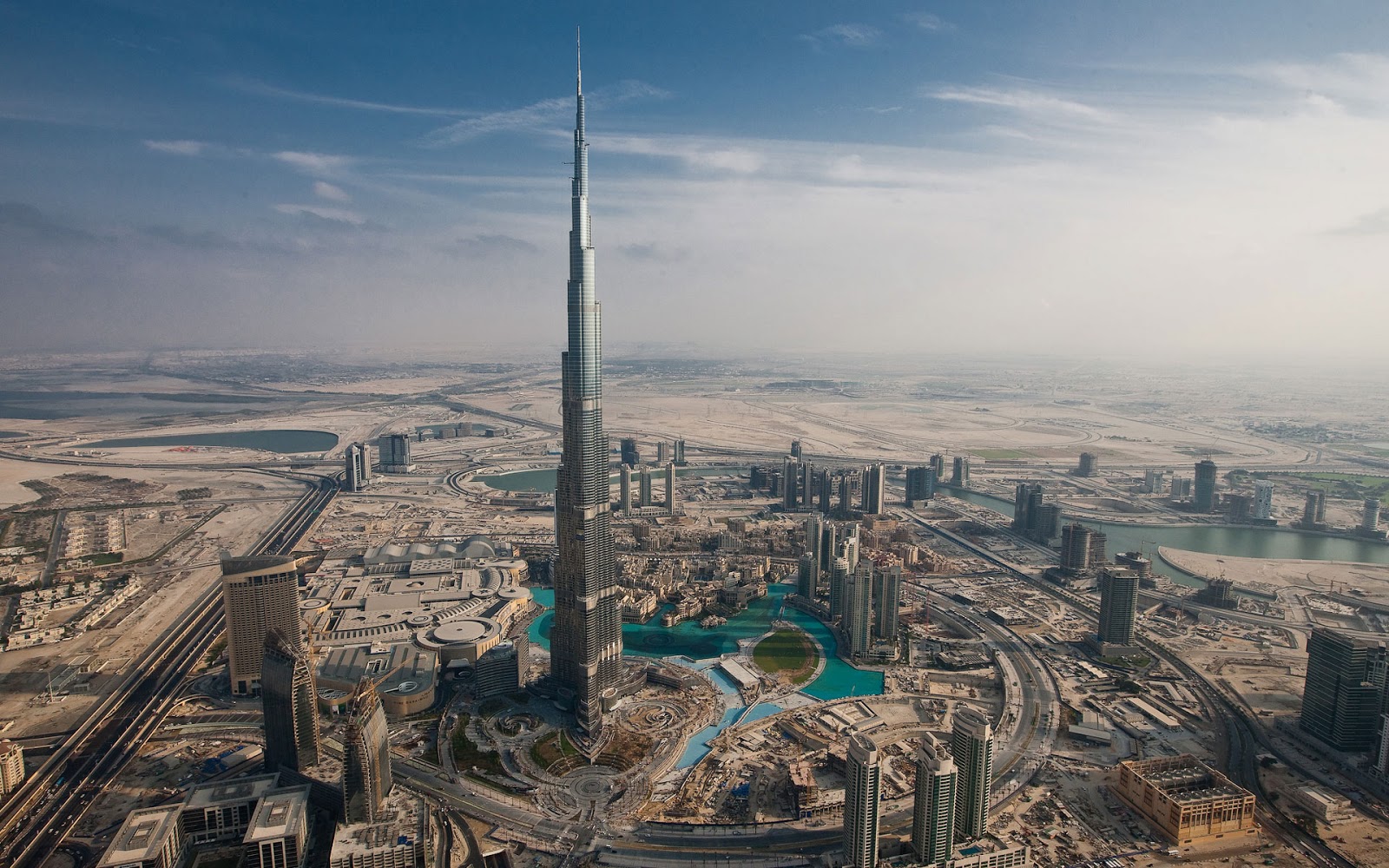
4. Burj Khalifa

Towering at 828 meters, Dubai’s Burj Khalifa is, by far, the tallest building in the world. This 160-storey skyscraper designed by Chicago’s Skidmore, Owings & Merill LLP is also the world’s tallest free-standing structure. Apart from that, this edifice is known to have the highest number of storeys, the elevator with the longest travel distance, the highest outdoor observation deck, the highest occupied floor, and the tallest service elevator in the world. The unique design of Burj Khalifa, which is an abstraction of the Hymenocallis flower, has made the building a complete standout.
5. Skipark 360

A gigantic structure solely intended for indoor ski purposes, The Skipark 360 in Stockholm is a $220 million structure that is scheduled to open in 2015 . This would-be greenest ski resort shows off a downhill slope that stretches 700 meters and a drop that is 160 meters high. With that said, it comes as no surprise why it is regarded as one of the biggest buildings in the world.
It is the only indoor ski slope to meet the requirements to host the World Cup. When completed, the complex will also house a 3.5-kilometer skiing tunnel; an arena for biathlon, bandy, figure skating, and ice hockey; and a snow park. The Skipark 360 is powered by wind, solar, geothermal, and hydropower.
6. Solar City

Measuring 75,000 square meters, the sundial-inspired Solar City in Dezhou, Shangdong Province in northwest China is justly branded as the biggest solar-powered building in the entire planet. The edifice is the focal point of China’s ambitious “Solar Valley City,” signifying the nation’s effort to seek renewable energy sources. It houses a sustainable hotel and provides space for exhibition centers, scientific research facilities, and training and meeting facilities.

With a name that roughly means the “tent of the king,” The Khan Shatyr Tent in Astana, Kazakhstan is the biggest tent-like building in the world. Ten football stadiums can fit under this tensile structure that has a 139,354 square-meter foundation.
In the center of the Khan Shatyr is a tripod that is 149 meters high and weighs 907 kilograms. This unconventional structure has a leaning, needle-like tip. Its construction was manned by 650 professional mountain climbers. The Khan Shatyr houses cafes, shops, rides, movie theatres, and an indoor beach.
8. The Basilica of Our Lady of Peace

The Basilica of Our Lady of Peace, located in Yamoussoukro, Cote d’Ivoire, is the world’s largest Christian church. The $300 million project is huge enough to accommodate 18,000 worshippers. The basilica, commissioned by the late President Félix Houphouët-Boigny of Ivory Coast, is adorned with French stained glass and Italian marble. Built between 1985 and 1989, it was ordained by Pope John Paul II in 1990.
9. Boeing Everett Factory

Situated in Everett, Washington, the Boeing Everett factory is not only the biggest in the world, but also the largest building in terms of volume. The facility opened for operation in 1967 to produce the 747 jumbo jet.
The factory represents Boeing to the world by its size and magnitude. This 13 million cubic-meter factory is the home of Boeing’s 747, 767, 777, and 787 Dreamliner, the newest twin-aisle airplane. The Everett factory is open for public tours seven days a week.
10. Aalsmeer Flower Auction

With a floor space of 990,000 square meters, Aaalsmeer Flower Auction is rightfully labeled as one of the largest buildings in the world. This gigantic plant and flower auction building has 20 million flowers from around the world being traded inside it each day. Workers busily roam around the facility using 270,000 trolleys. Aside from where the flora gets housed, the building contains 13 auction rooms and 40 auction clocks.
These structures all hold indispensable proof that size does matter engineering and architectural adeptness has indeed gained greater sophistication by the day, and the race to creating bigger and bolder structures never ends.